


Every active has a target. For retinoids, it’s the living cells of the epidermis, just under the surface. For actives targeting collagen, it’s the fibroblasts in the dermis. For volume, it’s the fat cells, which start in the dermis around the hair follicles.*
The skin’s stratum corneum – the outermost layer – evolved to keep things out. Small, oily molecules can slip through. Larger ones, like most peptides, barely get past it.
So does your expensive “science-backed” serum even reach its target?
Here we present two ways to answer the “does it get there” question.
*Deeper doesn’t always mean harder to reach. Hair follicles run down through the dermis, and some fat cells sit right at their base, so follicles may offer a shortcut to fat that the fibroblasts in between don’t get.
The First Way: Show that it affects the target cells
The most obvious and clearest evidence is that applying the ingredient to the skin* leads to desired changes in the target cells.*

To employ this path, you need to know the specific effect that you want your active to show. Here we present four small molecule examples where the desired effect is well known.
Capsaicin is the compound that makes chili peppers hot. It acts directly on a receptor called TRPV1, found on the nerve endings that reach up into the epidermis. You will feel the burn within minutes of putting capsaicin on your skin. The burn tells you that the TRPV1 receptor is firing. Repeated use will cause the nerve endings to wither, reducing pain sensitivity. A known target, a direct effect, and both measured in human skin.
Topical corticosteroids have another specific effect. They constrict the small blood vessels in the dermis. As a result, the skin becomes paler. The FDA treats this “blanching” as evidence that the steroid reached its target. In fact, a manufacturer of a generic steroid cream can claim that its product works as well as a branded steroid cream based on a similar “blanching effect.”
At Adipeau, we wanted to show that KPRE could make dermal fat cells smaller when applied to the skin. We applied our actual product to pieces of human skin kept alive in the lab, and looked at the fat cells. Where the fat cells were enlarged, their lipid droplets shrank significantly — within six days. It was a small study — two donors — and it doesn’t tell us how much KPRE got there. But it shows that something in the product reached the fat cells and acted on them.
We’re not the only ones to show this is possible. In a 2020 study, researchers at LG Household & Health Care applied 0.5% magnolol – from magnolia bark — to five volunteers’ skin. They applied it 3x per week for two weeks under occlusion. Biopsies showed smaller fat cells. It’s a bigger study than ours but it also used occlusion – which increases penetration — and a longer time frame to show an effect.
*Applying an ingredient to the skin should be simple. Apply a normal amount of the actual product under normal circumstances. This is not always true. To give their ingredients a boost, companies will sometimes use penetration enhancers that aren’t in the actual product. Or they may cover or “occlude” the product to make it penetrate more.
The Second Way: Measure how much arrives and compare to known efficacy levels.
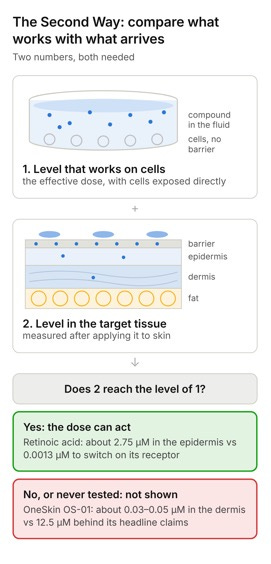
The Second Way compares two numbers.
The first number is the concentration of active needed to change cell function or structure when the active is exposed directly to the target cells. Think of this as the Petri dish number. You know how much liquid is in the Petri dish. You know how much ingredient you’ve put into the Petri dish. This allows you to calculate an effective dose – usually an effective dose is the dose needed to move the cells half-way in the desired direction.
The second number is the concentration of active found in the target tissue after application to the skin. The skin is typically stripped to get to the target tissue and that tissue is assessed for how much active ingredient is in there.
Both numbers are expressed the same way: in moles.* Moles is a measure of the number of active molecules per unit of fluid or tissue.
If the second number is bigger than the first number you can expect the product to work. If the second number is smaller than the first number, efficacy is suspect.
*A mole is a fixed, very large number of molecules (about 6 × 10²³). One micromolar is a millionth of a mole per liter. Because it counts molecules rather than weight, it lets you compare a small molecule and a big one fairly.
The Second Way: Small molecule vs. Peptide.
We have a perfect test case for how to apply The Second Way. In 1992, John Voorhees and colleagues at the University of Michigan did this for retinoic acid. Retinoic acid is a small molecule and oily, which we noted at the outset has a good chance of “getting there.” We also know the desired effect of retinoic acid. It needs to activate the retinoic acid receptor (RAR) in living keratinocytes, which reside below the stratum corneum.
The Voorhees group applied 0.1% retinoic acid cream to volunteers’ skin under occlusion for four days, stripped off the stratum corneum, and measured how much was in the epidermis beneath. They got a concentration of about 2.75 micromolar. That’s the second number.
The first number is much, much lower. It takes only about 0.0013 micromolar to switch on retinoic acid’s main receptor in skin halfway.
The target tissue concentration was roughly 2,000x bigger than what it needed to be. Arrival measured, dose matched.

Now we present the case of an expensive “science-backed” peptide: OS-01.
This peptide is supposed to turn senescent cells back to normal. There are multiple types of senescent cells in the skin, but the sexiest one is the fibroblast, the cell that makes collagen, elastin and hyaluronic acid. These cells reside mostly in the lower part of the dermis.
The Petri dish claims for this molecule are head-spinning. The company says it cuts senescence in UV-damaged fibroblasts by 42.5%, suppresses markers of inflammation, and turns up gene markers for collagen and hyaluronic acid by 179% and 246%, respectively.
The concentration at which it has these eye-popping effects is 12.5 micromolar. That’s the first number.
So what about the second number, how much of the molecule gets there.
OS-01 peptide is about 1,180 Daltons. So not a small molecule, and not lipophilic. And yet, its manufacturer found that about 1.7–2.2% of the dose applied to the skin got into the “dermis.”*
Assuming my estimate of size is current, this works out to roughly 0.03–0.05 micromolar concentration of the peptide somewhere in the dermis.
So this is the opposite case to retinoic acid. The second number is 250-400x smaller than the eye-popping first numbers.
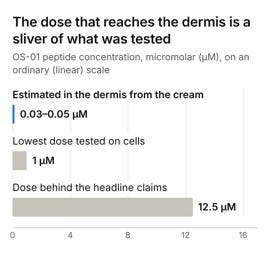
So does 0.03 micromolar do anything? Maybe. We just don’t have any evidence for it.
*This was a small study with a formula that differs from the actual product. The details are limited. For example, we don’t know which part of the dermis was measured.
Rule of thumb. Small molecules get there better than large ones.
In 2000, two dermatologists from Amsterdam observed that almost every active molecule that readily penetrates the skin – including virtually every common contact allergen — weighs less than 500 Daltons. Above that, molecules have a hard time getting past the stratum corneum at all.
Lucas Meyer Cosmetics, a company that makes a penetration enhancing liposome formula – tested a small molecule (caffeine) and a large peptide molecule (acetyl hexapeptide-38) head-to-head. Each was applied to human skin in a lab chamber, either dissolved in water or packaged in liposomes, and measured in each skin layer 24 hours later.
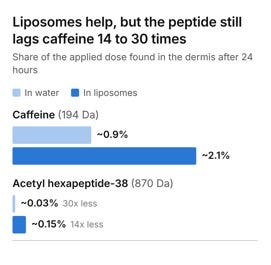
Liposomes helped both. But even with help, the peptide reached the dermis at 14 to 30 times lower levels than caffeine.
Size isn’t the whole story. Charge and oiliness matter too. Methylene blue, a dye, weighs only about 320 Daltons, but it’s charged and water-loving, and it barely crosses the stratum corneum on its own.
Hyaluronic acid is the big exception. It weighs tens of thousands of Daltons or more, far past the 500 mark. Yet in a 2016 study that used Raman imaging to track it in human skin, forms of 20,000 to 300,000 Daltons passed through the stratum corneum.*
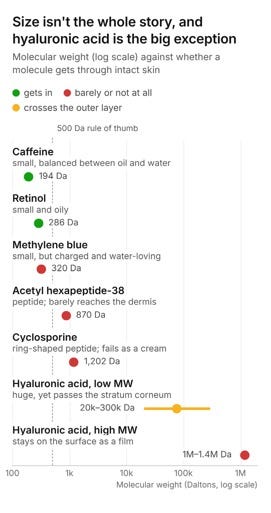
So a small molecule isn’t guaranteed to get in, and a big one usually won’t, though there are exceptions. Size is a reason to ask for data, not a verdict. And a bigger peptide – even if it’s “science-backed” should make you ask harder questions.
*Hyaluronic acid gets in by rearranging the stratum corneum. We’re going to do a story about that later.
Before you believe a claim, ask.
1. Where does the target cell live? Epidermis, dermis, fat?
2. Is there evidence the ingredient did something to those cells after being applied to skin, not just in a dish?
3. If not, did anyone measure how much reaches the target tissue?
4. Is that amount anywhere near the amount that worked on cells directly?
If a brand can’t show you either the effect at the target or numbers that line up, the rest of the story doesn’t matter much.
Extra credit:
5. Is the big number behind a claim a gene marker, or an actual change in protein or tissue?
Gene changes don’t necessarily translate into actual protein changes. And protein changes don’t necessarily mean that there are meaningful tissue changes.
I should be upfront about my own bias. I run a skincare company, Adipeau, and I’ve used our own work as an example.
And try it yourself. Pick your favorite hero ingredient, run it through these questions, and tell me what you find. I read the replies.
Sources
• Nolano M, et al. Topical capsaicin in humans: parallel loss of epidermal nerve fibers and pain sensation. Pain 1999;81(1):135–145.
• US FDA. Topical Dermatologic Corticosteroids: In Vivo Bioequivalence, guidance for industry.
• Magnolol induces adipogenic differentiation in human skin. Br J Dermatol 2020. doi:10.1111/bjd.19063
• adipeau.com/science (Adipeau skin explant study).
• Alastin Skincare, US patent 11,103,455, Liposomal compositions and methods of use, Example 2 and Figures 3A–3C.
• Bos JD, Meinardi MM. The 500 Dalton rule for the skin penetration of chemical compounds and drugs. Exp Dermatol 2000;9(3):165–169.
• Duell EA, et al. Human skin levels of retinoic acid and cytochrome P-450-derived 4-hydroxyretinoic acid after topical application of retinoic acid in vivo compared to concentrations required to stimulate retinoic acid receptor-mediated transcription in vitro. J Clin Invest 1992;90(4):1269–1274. PMID 1328295.
• Zonari A, et al. Senotherapeutic peptide treatment reduces biological age and senescence burden in human skin models. npj Aging 2023;9:10. PMID 37217561. Figure 6c, Supplementary Figure 11 and Supplementary Table 5.
• OneSkin, Peptide 14 patent, US 12,268,747.
• OneSkin, OS-01 lab claims and disclaimers (source of the 42.5%, 179% and 246% figures).
• Essendoubi M, et al. Human skin penetration of hyaluronic acid of different molecular weights as probed by Raman spectroscopy. Skin Res Technol 2016;22(1):55–62.
• Lucas Meyer Cosmetics (IFF), Pro-Lipo Neo product listings: UL Prospector and Safic-Alcan.
• Improvement of cutaneous delivery of methylene blue by liquid crystals. Int J Pharm 2018;548(1) (methylene blue’s limited passage through the stratum corneum).
• Tacrolimus for the management of psoriasis: clinical utility and place in therapy. Psoriasis: Targets and Therapy 2016;6 (topical cyclosporine ineffective due to poor skin penetration).