


A few years ago, bakuchiol was introduced to the world as a natural alternative to retinol. It all started with a clinical study published in the British Journal of Dermatology, which compared bakuchiol to retinol head to head.
Before the big study, nobody was paying attention
The story actually started way earlier. Sytheon, the company that manufactures bakuchiol, first published a paper on the “retinol-like” qualities of bakuchiol in 2014.
No one paid much attention to it, and for good reason. It was published in a journal with a generally low reputation, and the lead author was from Sytheon. There was no evidence that bakuchiol acted on the same pathways as retinol. In fact, it was abundantly clear that bakuchiol did not activate the classic nuclear receptors that retinoids activate. The clinical “data” was flimsy. The study wasn’t registered, had no control group, wasn’t blinded, and didn’t have IRB approval.
So things got more serious in 2018, when the British Journal of Dermatology accepted a study that claimed to be the real thing. This time its authors came from notable academic institutions, including the University of California, Davis in Sacramento and the University of Michigan.
This study “made” bakuchiol. It’s no surprise that shortly after it came out, Dr. Sam Bunting’s blog cited it and shared the results uncritically. Others quickly piled in, and Dr. Anil Rajani even called bakuchiol a “retinol killer.” But he clearly hadn’t read the original Sytheon paper, because he says bakuchiol works through the same receptors as retinol, which it doesn’t.
Dermatologists and influencers were saying:
“It helps prevent the fine lines and wrinkles, and with pigmentation, elasticity and firmness. You know what retinols do. They’re time-proven, tested, people are used to them. But what I like about it is it works through the same receptors that retinol uses.”
“Does it do the same thing as retinol? It’s thought to have a lot of the same clinical benefits. It’s thought to work in a different way, but have kind of a similar end point, both on a cellular level and then clinically as well. There’s now some decent quality data supporting its actions in the skin in real people. The paper of note that has struck me is the one published in the British Journal of Dermatology, which is a respected journal.”
That seems like it makes sense, right? The British Journal of Dermatology is a reputable journal, so if a clinical study was published there, especially by seemingly independent academic researchers from the University of Michigan and UC Davis, you’d believe it.
Well, in my view, this “bedrock” study is worthless, and actually fake, and the clinicians who ran it deceived not only the reviewers at the British Journal of Dermatology, but the public at large.
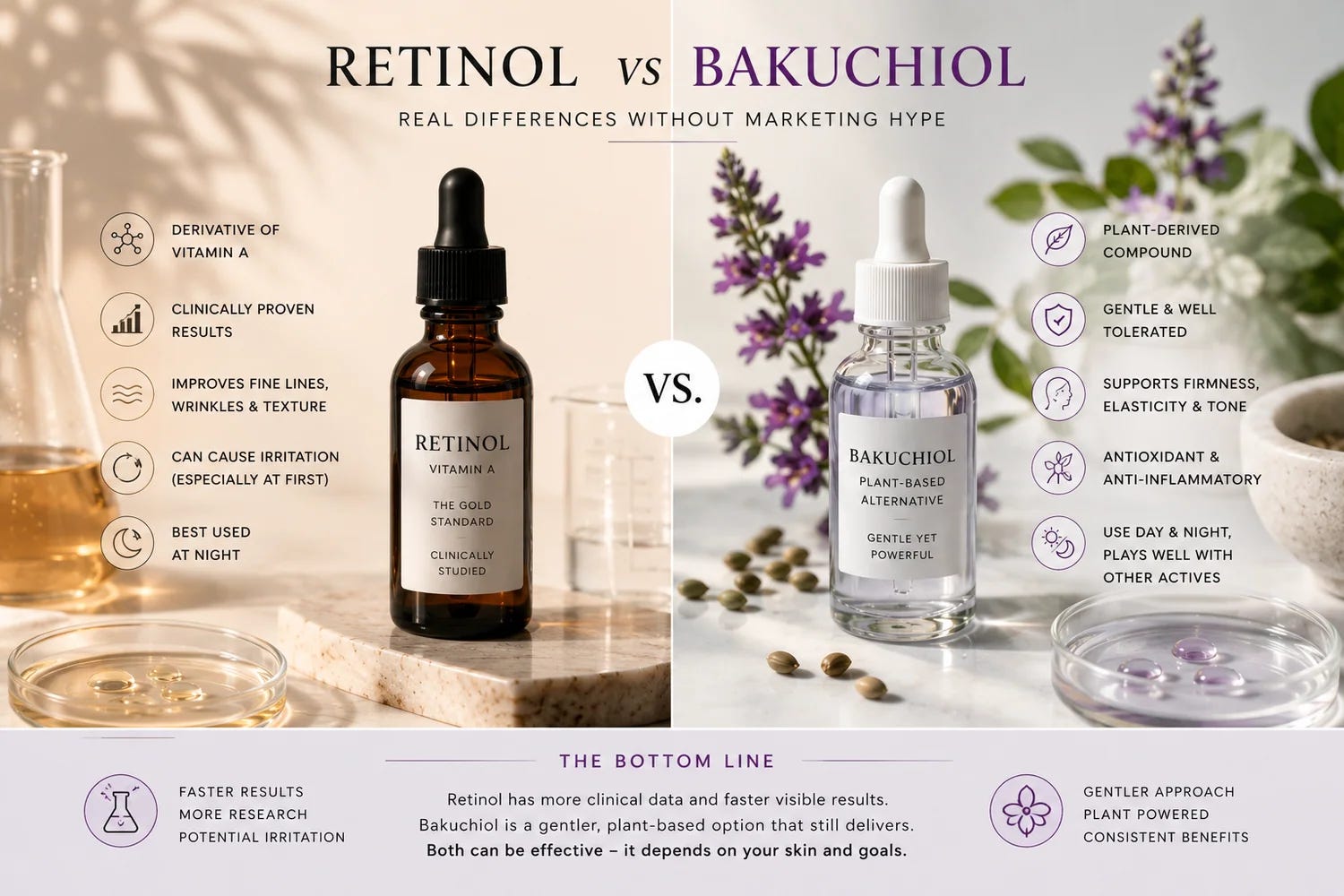
How do you cheat in a clinical study?
It actually isn’t hard to cheat, even in a clinical study. When the referee isn’t watching, you can cheat.
The most common form of cheating in clinical studies is to change the definition of success after you’ve seen the results. And this is what the bakuchiol researchers did.
The first protocol they submitted to ClinicalTrials.gov is dated April 7, 2017, by which point the study had already started. The primary endpoint was poorly defined: they said they were going to assess wrinkle appearance and pigmentation, but they weren’t very clear about what they meant.
They also made one very clear mistake. The protocol said they would photograph the subjects before and after to measure wrinkle appearance and pigmentation, and that board-certified dermatologists would grade those photographs on a Likert scale.
But they didn’t do that.
The study was completed in November 2017. Then, on May 5, 2018 (after the study was over), a new protocol was submitted that changed the endpoint. This time the photographs wouldn’t be graded by dermatologists; instead, they would use imaging-based analysis.
See it to believe it. This is the record, and the history of changes.
What makes this case particularly egregious is that they didn’t even specify how the imaging would be used. Basically, what happened is they said, “We’re going to change the rules, and we’ll tell you exactly how later.”
They don’t explain why they made that change or why they made it after the study was over. So who made this decision, and why?
The 100-meter race that ends at 23 meters
Let’s look at an equivalent. You organize a 100-meter race and tell the runners the distance that they’re racing (100 meters). The runner you wanted to win doesn’t win. So you go back and look through the footage. You see that at 23 meters, your runner was ahead. So you say, “Now we’re going to pick the winner based on who was ahead at 23 meters.” Your runner won!
That’s what happened here. The definition of success was changed in a very deceptive manner.
Cherry-picking after moving the goal line
After moving the goal line, they also cherry-picked, but that only became visible when the manuscript was published.
The imaging software they used can produce 33 different measures of wrinkle appearance and pigmentation. But the researchers reported only one measure of wrinkles and two measures of pigmentation. And they didn’t explain why those three represent the “efficacy” of bakuchiol and retinol and the other 30 don’t. They didn’t even report the results on the other 30. Have a look at the software for yourself.
Logically, if you take 33 measures and get only three “positives,” you have clearly failed.
So what happened? The study was completed. The photographs were taken, and the dermatologists graded them. Someone looked at those results and said, “These aren’t that great. Let’s measure something else.” So they ran the imaging-based analysis and picked the three that showed equivalence between retinol and bakuchiol. What is even more laughable is that even that equivalence is debatable.
Now do you see why this can truly only be viewed as cheating?
One last important detail: the study calls itself a prospective, blinded clinical trial. “Prospective” means the measure is set in advance. But that label was used without explaining how the endpoint was set prospectively, and without explaining how the blinding was done, or whether any blinding was done at all. This, in my view, is completely misleading.
The missing statistics
Oh, one more thing. The study doesn’t actually report the statistics for its primary endpoint.
I have actually never seen a clinical trial where the statistical evaluation of the primary endpoint goes unreported. This is unprecedented. I couldn’t believe it.
This is how the cosmetics industry works
Unfortunately, this is typical of studies we see in the cosmetics industry. Companies commonly measure 20 endpoints and then, after the fact, pick two or three and say that they are the ones they meant when they started the study.
Take a look at the so-called clinicals of any company that has produced a clinical study, and you’ll see two things.
First, you will see that they didn’t select a primary endpoint in advance. In my experience, almost no one picks one thing they are going to measure and define as success.
Second, if they do select a primary endpoint in advance, they alter how that endpoint is measured, in a way that’s favorable to them. And their statistics are bent.
What happened when I asked questions
I wrote to the authors and asked them to explain what looked to me like blatant cheating. They didn’t respond. I wrote again, and I called them. They still didn’t respond.
So on July 23, 2024, I wrote to the British Journal of Dermatology to see how they would respond. After months of prodding, I got this reply by email:
“We conducted an in-depth investigation and felt that the raised concerns do not warrant a retraction according to the COPE guidelines and that the issues have more to do with suboptimal reporting than data fabrication. However, you may wish to submit a formal Letter to Editor for possible publication, which the original authors can then respond to.”
In other words, they didn’t find evidence of plagiarism or fabrication, which are the only grounds on which they would retract a study.
To me, it’s fraud.
So I took them up on their invitation and wrote a letter to the editor, with references, formatting and everything in the format that they require. Within hours of submitting it, the letter was rejected, which is stunning speed for the British Journal of Dermatology. Here’s part of the response from the editor-in-chief, Prof. John McGrath:
“The trial you comment on was accepted by the BJD in Sept 2018 and published in 2019. I regard the time interval too long for the topic still to be of interest to the BJD readership. Your letter raises a number of points in the style of a reviewer reviewing the article. As such, I think you should contact the original authors directly and have a private communication about the points you have raised. Having discussed your submission with other current BJD editors, I’m afraid the decision is not to publish your letter. I would also like to close correspondence on the matter.”
It wasn’t that anything I said was untrue. It was that too much time had gone by and their readers wouldn’t be interested. I had already tried to contact the authors separately, several times.
It’s remarkable that these are the standards of the British Journal of Dermatology. Shame on you.
Who benefited
They should care, because this study was an incredible win for Sytheon. After the study, Sytheon started supplying hundreds of companies with bakuchiol to make new “natural alternatives to retinol.” Sytheon even publishes a chart of the number of bakuchiol brands launched each year, and attributes that success to the BJD study.
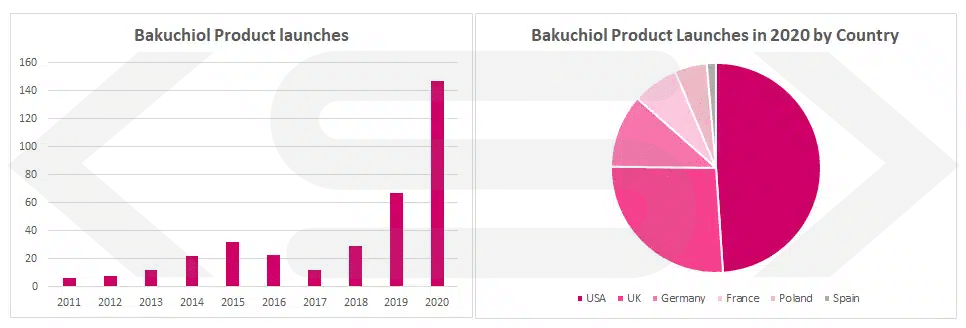
I don’t have as strong evidence for this as I do for the endpoint switching, but I believe the researchers misled us about why the study was done.
Why do such a poor study? My only idea is that it was to make bakuchiol look good. And for that to be the purpose, I’d expect there to be some financial incentive behind it.
The paper doesn’t explain where the funding came from. It makes it seem as though it came from UC Davis in Sacramento: that scientists there were simply curious whether bakuchiol was really a natural alternative to retinol, and put up the roughly $100,000 it would cost to run the study. I don’t think that’s what happened. But they don’t tell us, and when I wrote to them and asked them to explain the funding, they didn’t write back.
There’s one more gap in the manuscript. Normally, a study reports where the test agent came from. Did the researchers buy it from the company, which probably sponsored the study, or was it gifted? This paper doesn’t say. That leaves the door open to the possibility that the company supported the study and that this support went undisclosed.
Let’s hold them accountable
It’s unfair that the British Journal of Dermatology rejected my letter to the editor, so I’m asking for your help.
You can reach the British Journal of Dermatology at bjd@bad.org.uk. Please write to them and simply say, politely: We hear that you rejected the letter to the editor regarding the bakuchiol study, and we would like that letter to appear as quickly as possible.
Let’s hold these people accountable. Let’s stop accepting this as real clinical science.
Had you heard that bakuchiol was “the natural retinol”? Has it worked for you, or not? Tell me in the comments.