


Botox smooths the lines. But it may also be weakening the skin underneath.
I have been working with aestheticians around the world, and they keep saying the same thing: clients who get Botox usually have weak, brittle skin that is difficult to work with.
So what is Botox doing to the skin? I think the answer is clear once you look at how Botox works. Keep reading for my best attempt to explain this, with full disclosure on where the evidence is solid, where it is missing, and where I am speculating.
What Botox does
Botox paralyzes muscles by inhibiting contraction. A muscle that cannot contract cannot crease the skin above it.
But muscle contraction also has an important job with for the lymphatic system on the face. The lymphatic system is essential to facial skin health and relies on muscle contraction to clear lymph fluid. When contraction is reduced, clearance is reduced.
My hypothesis
Here is the path I think runs from a Botox injection to weak skin:
Botox inhibits muscle contraction.
Less contraction means less lymph clearance.
Free fatty acids, a major component of lymph fluid, are not cleared. Fat cells take them up and become bloated.
Bloated fat cells signal the fibroblasts in the skin to stop making collagen and elastin, and to start making enzymes that degrade collagen.
If you have followed my work, you know the last step: bloated fat cells lead to weak skin. The new part is the first three steps.
The study nobody has done
I prefer to base what I say on published, peer-reviewed literature. So ideally, I would point you to a paper measuring how much Botox injections in the face reduce lymph clearance.
The issue is that this study has not been done. Although it could be.
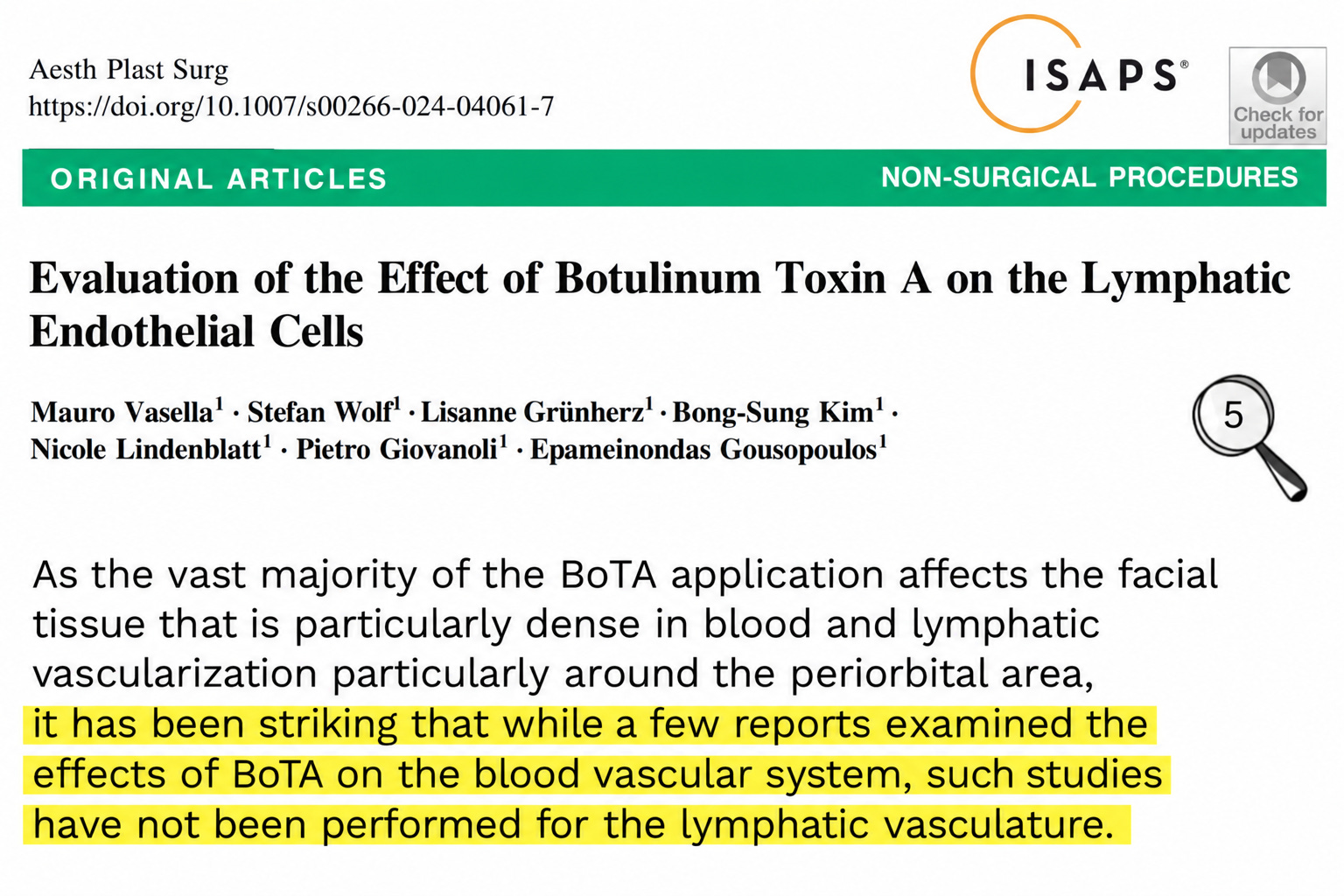
I am not the only one who has noticed this gap. A 2024 paper from a group in Zurich, looking at Botox and lymphatic cells, put it this way: “it has been striking that while a few reports examined the effects of BoTA on the blood vascular system, such studies have not been performed for the lymphatic vasculature” (Vasella 2024).
So I looked for indirect evidence.
A case you can see

I found a paper that shows Botox inhibiting lymph flow and causing swelling: “Nonallergic eyelid edema after botulinum toxin type A injection: case report and review of literature” (Chang et al., Medicine, 2015).
The patient received Botox injections for crow’s feet. In the before photos, she is smiling with her eyes. Three days after the injection, there is darkening and swelling, most prominent in the upper eyelids. Two weeks after, significant facial swelling remains.
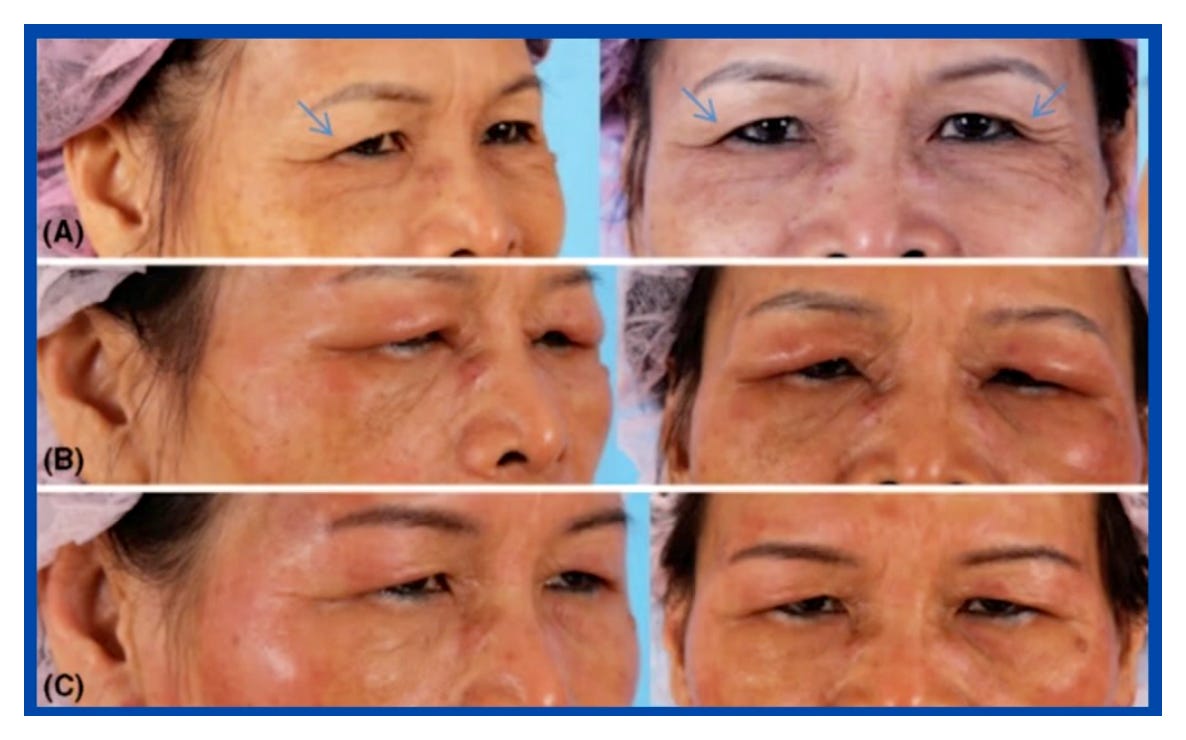
Her doctors treated her successfully by having her blink repeatedly, along with warm compresses. The blinking was the key: it forced the muscles to contract through the Botox, and that contraction cleared the lymph.
This is the mechanism in a single patient. When the muscle stops working, the fluid accumulates. When the muscle works again, the fluid clears.
How common is it?
The paper also asks how representative this case is.
The authors cite a meta-analysis by Brin et al. of 1,678 participants treated only for glabellar lines and crow’s feet. In that population, about 1.4% developed clinically relevant eyelid edema, meaning swelling visible enough for the clinician to note it.
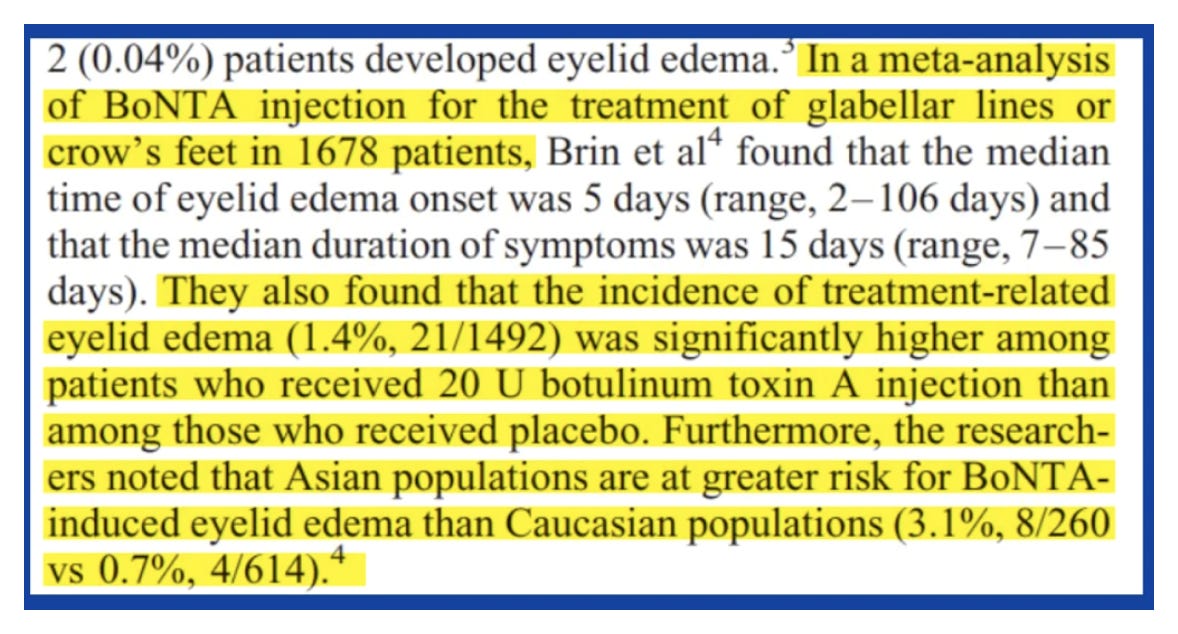
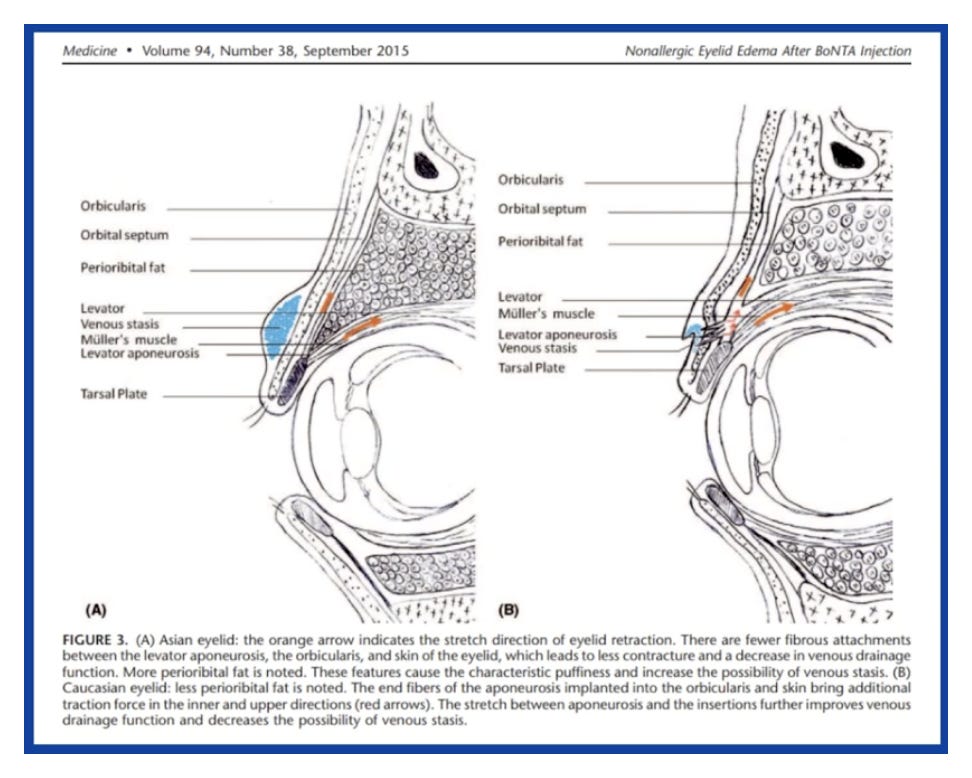
In Asian subjects, the rate was more than double, at 3.1%. Asian eyelids are structured differently from Caucasian eyelids, and I suspect a blink produces less contraction and therefore less force to clear the lymph. If that is correct, it would make them more susceptible to this effect, which fits the idea that loss of contraction is what matters.
The tip of the iceberg
Is 1.4% a lot?
I think these are the most visible cases, the ones obvious enough that people return to the doctor and say, “My eye is swollen. Please do something.”
People without visible swelling, I would argue, are still experiencing reduced lymph clearance. Based on what I see, I would estimate a reduction of 30 to 50%, but this has not been measured. If I am right, it happens every time they are injected.
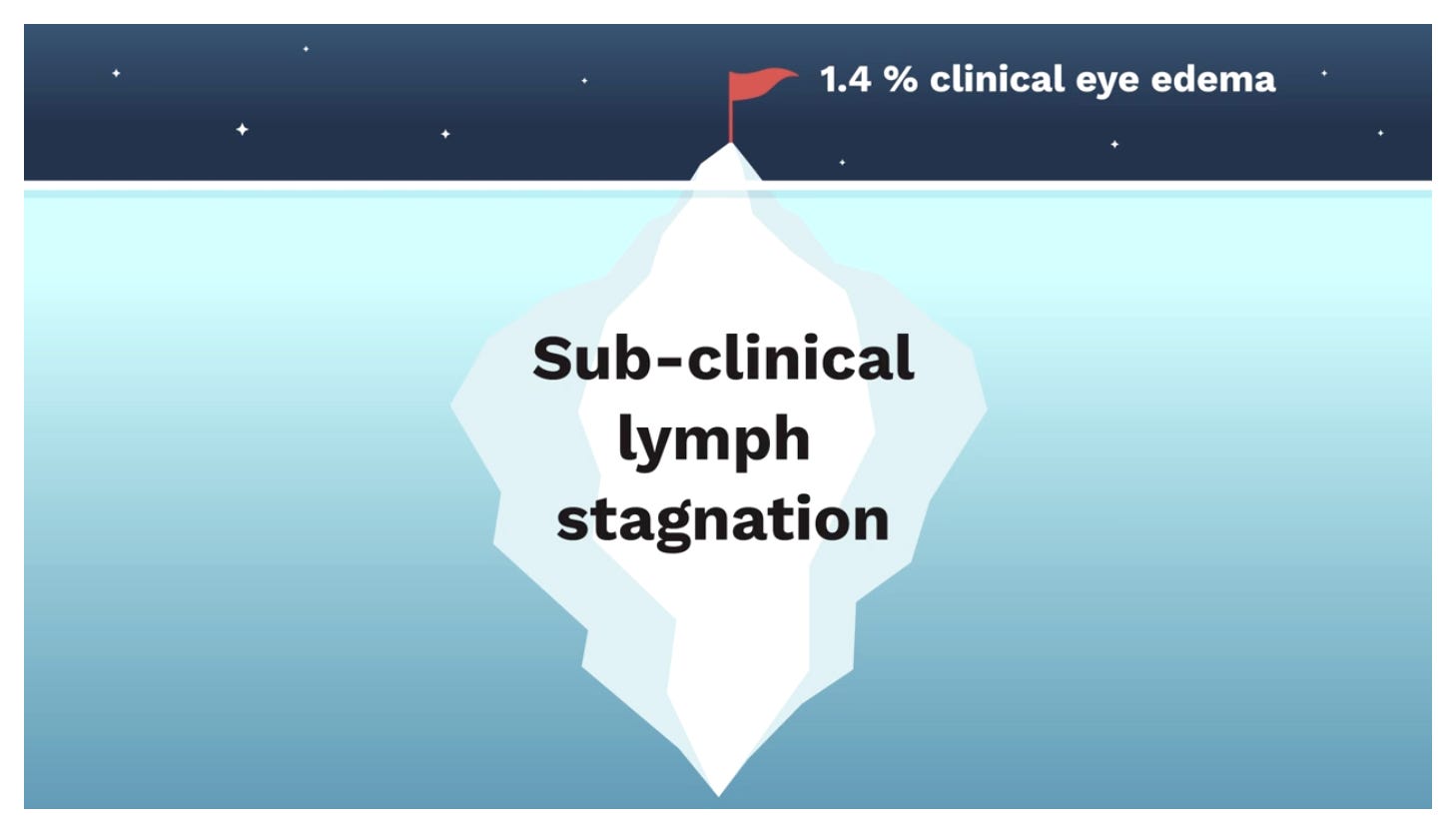
As I have covered before, a difference in fat cell size of less than 10% is associated with meaningful increases in inflammation (Henninger 2014). Inflammation, in turn, weakens skin structure.
That would explain what aestheticians are seeing in clients who get Botox repeatedly.
What we don’t know
I want to be clear about where this is solid and where this isn’t.
What is solid: Botox stops muscle contraction. In at least one well-documented case, this led to lymph accumulating in the face, and making the muscle work again cleared it. Visible eyelid swelling occurs in a measurable share of people treated for frown lines and crow’s feet.
What is missing: nobody has measured lymph clearance in the face after Botox. Nobody has measured fat cell size in people who get it regularly. Nobody has followed the skin of repeat Botox users to see whether collagen and elastin decline. The 30 to 50% figure is my estimate, not a measurement. The difference in blink force in Asian eyelids is my interpretation, not a published finding. The brittle skin is what aestheticians report, not a published study.
So this is a hypothesis built from a case report, a meta-analysis, what we know about bloated fat cells, and what people who work with skin every day are observing. I think it is a strong one. It needs testing.
If you work on faces
Some of you are probably thinking, “Ivan, of course.”
Those of you who practice facial massage and gua sha already know that stagnant lymph means weak skin. You have felt it under your hands.
What I do not think has been discussed is the link to Botox. If this hypothesis is correct, the weak, difficult skin you see in regular Botox clients is not a coincidence. It is what happens when the muscles that move lymph are switched off, again and again.
Tell me if I’m wrong
This is new ground, so I would like to hear from you. If you are an aesthetician, what are you seeing in your Botox clients? If you get Botox yourself, have you noticed changes in your skin? And if you think I have the science wrong, I want to hear that too. Leave a comment below or reply to this email. I read every message.
Thank you for all of your support.
Sources
Vasella M, Wolf S, Grünherz L, Kim BS, Lindenblatt N, Giovanoli P, Gousopoulos E. Evaluation of the effect of botulinum toxin A on the lymphatic endothelial cells. Aesthetic Plast Surg. 2024;48(21):4513–4522. doi:10.1007/s00266-024-04061-7.
Chang YS, Chang CC, Shen JH, Chen YT, Chan KKW. Nonallergic eyelid edema after botulinum toxin type A injection: case report and review of literature. Medicine (Baltimore). 2015;94(38). PMID: 26402825.
Brin MF, Boodhoo TI, Pogoda JM, James LM, Demos G, Terashima Y, Gu J, Eadie N, Bowen BL. Safety and tolerability of onabotulinumtoxinA in the treatment of facial lines: a meta-analysis of individual patient data from global clinical registration studies in 1678 participants. J Am Acad Dermatol. 2009;61(6):961–970.e11. doi:10.1016/j.jaad.2009.06.040.
Henninger AM, Eliasson B, Jenndahl LE, Hammarstedt A. Adipocyte hypertrophy, inflammation and fibrosis characterize subcutaneous adipose tissue of healthy, non-obese subjects predisposed to type 2 diabetes. PLoS One. 2014;9(8):e105262. doi:10.1371/journal.pone.0105262. PMID: 25148116.