


In December 2014, The Times published an article titled “Are you suffering from ‘gym face’?” The term was already in circulation among cosmetic doctors, journalist Peta Bee just put it front and center for us consumers.
The pattern she described is familiar. Someone in their late thirties or forties takes up running, cycling, rowing or a hard martial art. While the body gets leaner and looks younger, the face goes the other way: hollow cheeks, drawn features, a look friends describe as tired or older. The doctors she interviewed saw it most in endurance athletes, and mostly in the cheeks.
Exercise is great for the whole body, and it’s great for the skin too. But for the skin, it comes with an important side effect: the loss of superficial fat. That’s the layer just under the skin that gives the face its volume.
I’ve been thinking about gym face for years. I think it’s real. I also think the standard explanation is incomplete. What follows is my best attempt to explain how it happens, with an honest account of where the evidence is strong, where it’s thin, and where I’m guessing.
The easy explanation
The usual answer is body fat. Train hard, get lean, and the face loses fat along with everything else. One doctor in the Times piece, Tracy Mountford, described it as an unfortunate trade-off of keeping body fat low.
That’s partly right. If you lose a lot of weight, some of it comes off your face. But it leaves two things unexplained.
First, why does the face look worse than the body? A lean, fit body reads as young. A lean face often reads as old. If this were only about total fat, you’d expect the two to move together.
Second, why doesn’t the face come back? One surgeon in the article noted that when people regain weight, the face is often the last place to show it. A man who cut back on jujitsu after an injury stayed gaunt anyway. If gym face were just empty fat cells, refilling them should be easy. It isn’t.
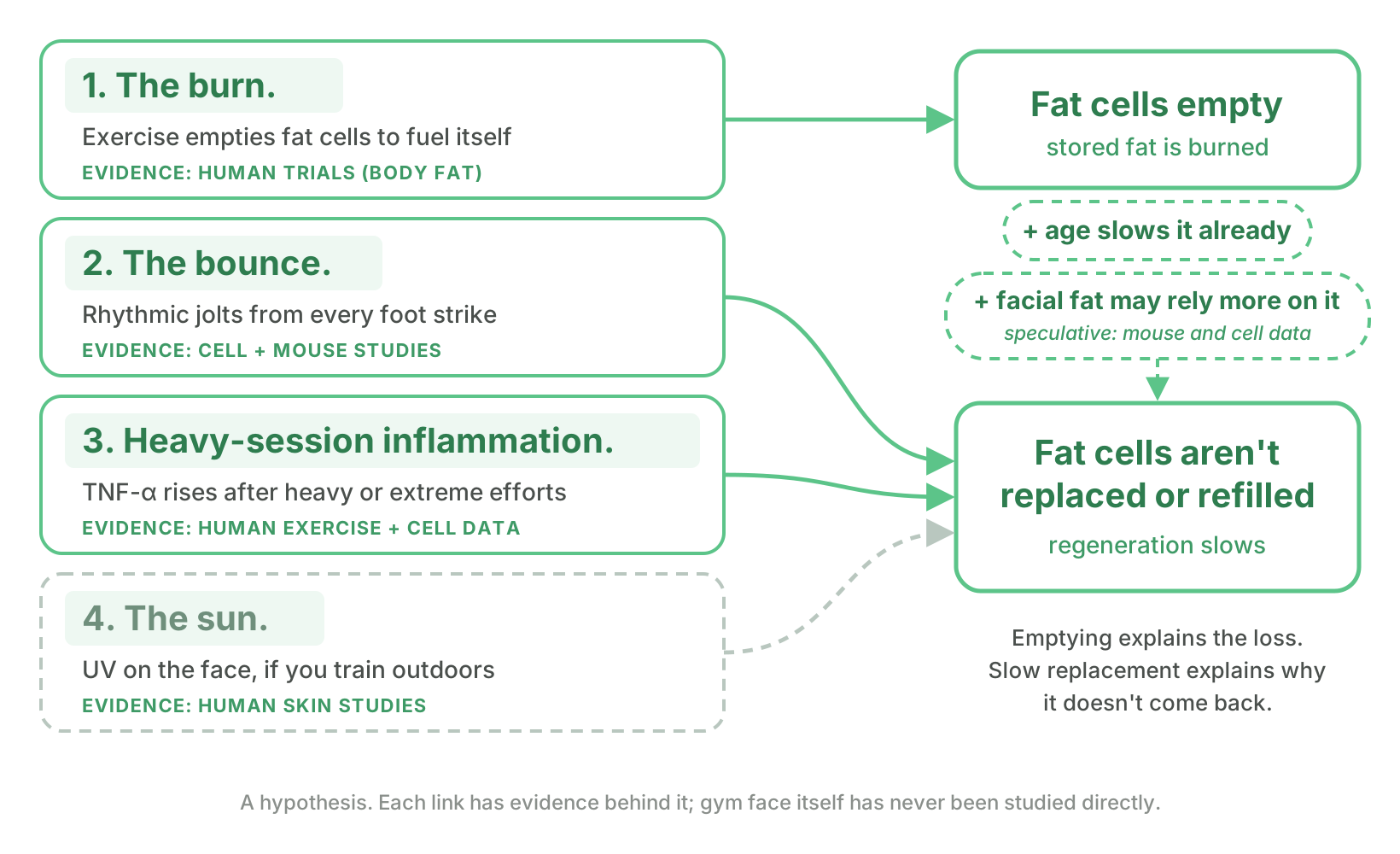
So here’s my hypothesis. Gym face has two halves. Training empties fat cells all over the body, and the face is unlikely to be the exception. And several things that come with intense training slow down how fast those cells get replaced, and some of them hit the face specifically. The first half explains the loss. The second explains why it doesn’t come back, and maybe why the face is hit harder than the body.
Suspect 1: the burn
I want to give the easy explanation its due, because it’s stronger than people make it sound. Exercise doesn’t just make you leaner in general. It actively empties fat cells. During and after a hard session, your fat tissue releases stored fat for your muscles to burn.
Part of the signal comes from the muscles themselves. Working muscle releases IL-6, and IL-6 helps drive fat release. In a 2019 trial in Copenhagen, adults with abdominal obesity cycled for 12 weeks. Exercise cut their deep belly fat by about 8%. In the group given a drug that blocks IL-6, that loss disappeared (Wedell-Neergaard 2019). Fat just under the skin joins in too. After an hour on a bike, the fat under the skin of the abdomen ramps up its own IL-6 output, in step with the fat it’s releasing (Lyngsø 2002).
So a hard trainer’s facial fat cells are very likely being emptied too, session after session. As I’ll get to, facial fat may give up its fat less readily than belly fat. And I can’t tell you how fast it happens in the face. Nobody has measured it there, and the trial was in belly fat, not faces.
But it can’t be the whole story. Emptied fat cells can refill. That’s what weight regain is. If gym face were only the burn, the face would fill back in when training eased. It often doesn’t. The rest of this post is about why.
Why the face may be different
Here’s the part I think explains why the face goes first. It’s also the most speculative part of this post.
In deep body fat, the number of fat cells is remarkably stable in adults. Radiocarbon dating shows about 10% of them are replaced each year. When people lose a lot of weight, their fat cells shrink, but there aren’t fewer of them (Spalding 2008). So when the weight comes back, the same cells refill. Body fat runs mostly on size.
Facial and dermal fat may run more on renewal. In mice, the fat layer in the skin turns out new, mature fat cells within 11 to 14 days under normal conditions, in step with the hair growth cycle. Deeper fat takes up to eight weeks, and only when the animal is overfed. The authors suggest skin fat is built for constant turnover, while the deeper depot is comparatively dormant (Rivera-Gonzalez 2025). In human cells, more precursors from the face turned into fat cells than precursors from the belly, and they kept that ability through 11 rounds of growth versus 5. The facial fat cells also released less fat when hit with an adrenaline-like drug, and had 60% less of the receptor that senses it (Chon 2015).
If that holds up, the face depends more on making new fat cells than on refilling old ones. Anything that slows regeneration would hit it harder than the belly. That would answer both questions from the top: why the face looks worse than the body, and why it doesn’t come back when the weight does.
I want to be clear about how thin this is. Nobody has measured fat cell turnover in human facial or dermal fat. The fast-renewal data are from mice. The facial cell data are from a dish. It’s a plausible idea that fits the pattern. It isn’t established.
Suspect 2: the bounce
Fat cells can feel mechanical force, and the kind of force matters. The best summary I know is a 2012 review by Naama Shoham and Amit Gefen at Tel Aviv University.
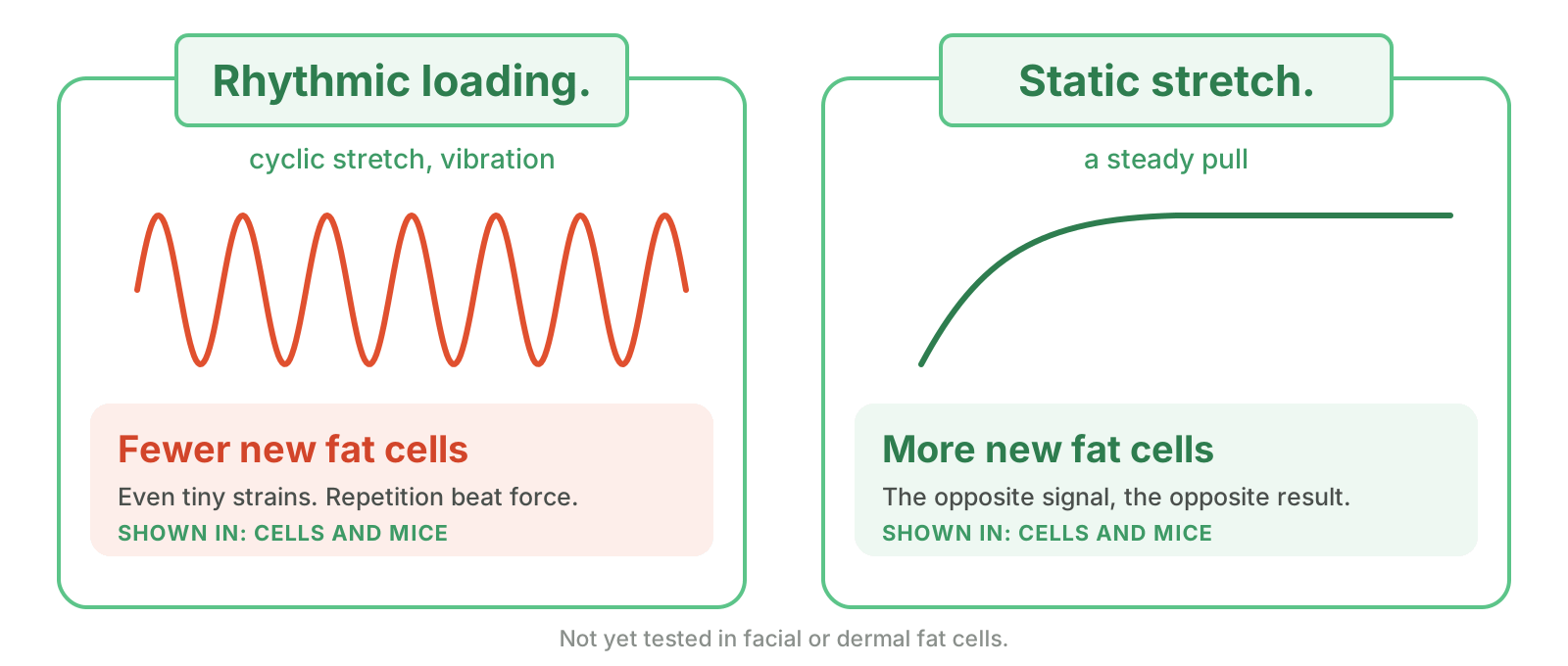
The consistent finding in cell culture: repeated, rhythmic loading suppresses the formation of new fat cells. Cyclic stretching blocked it in mouse preadipocytes (Tanabe 2004), in human umbilical cord progenitor cells (Turner 2008) and in mouse stem cells (Sen 2008). Vibration did the same in human adipose stromal cells (Tirkkonen 2011). Different labs found different signaling pathways doing the work. The direction was the same. And it held up in live animals: in mice, brief daily vibration, at less force than walking, cut new fat formation by about a quarter (Rubin 2007).
Two details stood out to me. In one study, vibration at strains below 0.001% still suppressed fat cell formation, and the number of loading sessions mattered more than their intensity (Sen 2011). And static stretch, a steady pull, seems to do the opposite and promote new fat cells (Hara 2011 in cells, Kato 2010 in mice). Fat cells appear to read the type of signal, not just whether there is one.
Now think about running. Every foot strike sends a jolt up through the body, and the soft tissue of the face moves with it. That’s thousands of cycles an hour, several times a week, for years. It’s the same idea behind what I call rockstar mouth: the areas of the face that move the most lose volume first.
Here’s what I can’t tell you. None of these studies used facial or dermal fat cells. Nobody has measured how much facial tissue actually strains during a run. And the review’s authors caution that fat loss in whole-body vibration studies in animals and people may come partly from muscles burning glucose, not from the fat cells sensing the vibration directly. So the cell and mouse data support the mechanism. They don’t prove it’s happening in your cheeks.
Suspect 3: heavy-session inflammation
Over months and years, exercise lowers inflammation. That’s well established, and it’s one reason exercise is so good for you. But a hard enough session can raise it briefly first.
The signal I care about is TNF-α. In the lab, it’s one of the most reliable blockers of new fat cell formation. And when I went looking at how exercise affects it, I found something I didn’t expect. It has a threshold.
After moderate cardio or short interval sessions, TNF-α in the blood doesn’t measurably move (Windsor 2018). After heavy lifting to failure, it rises about 30% and is back to baseline within a day (Townsend 2015). After a marathon, studies range from no change to more than double (Ostrowski 1999; de Sousa 2021; Ramirez 2025). After ultramarathons, some studies find rises of 20 to 70%, and others find nothing (Waśkiewicz 2025).
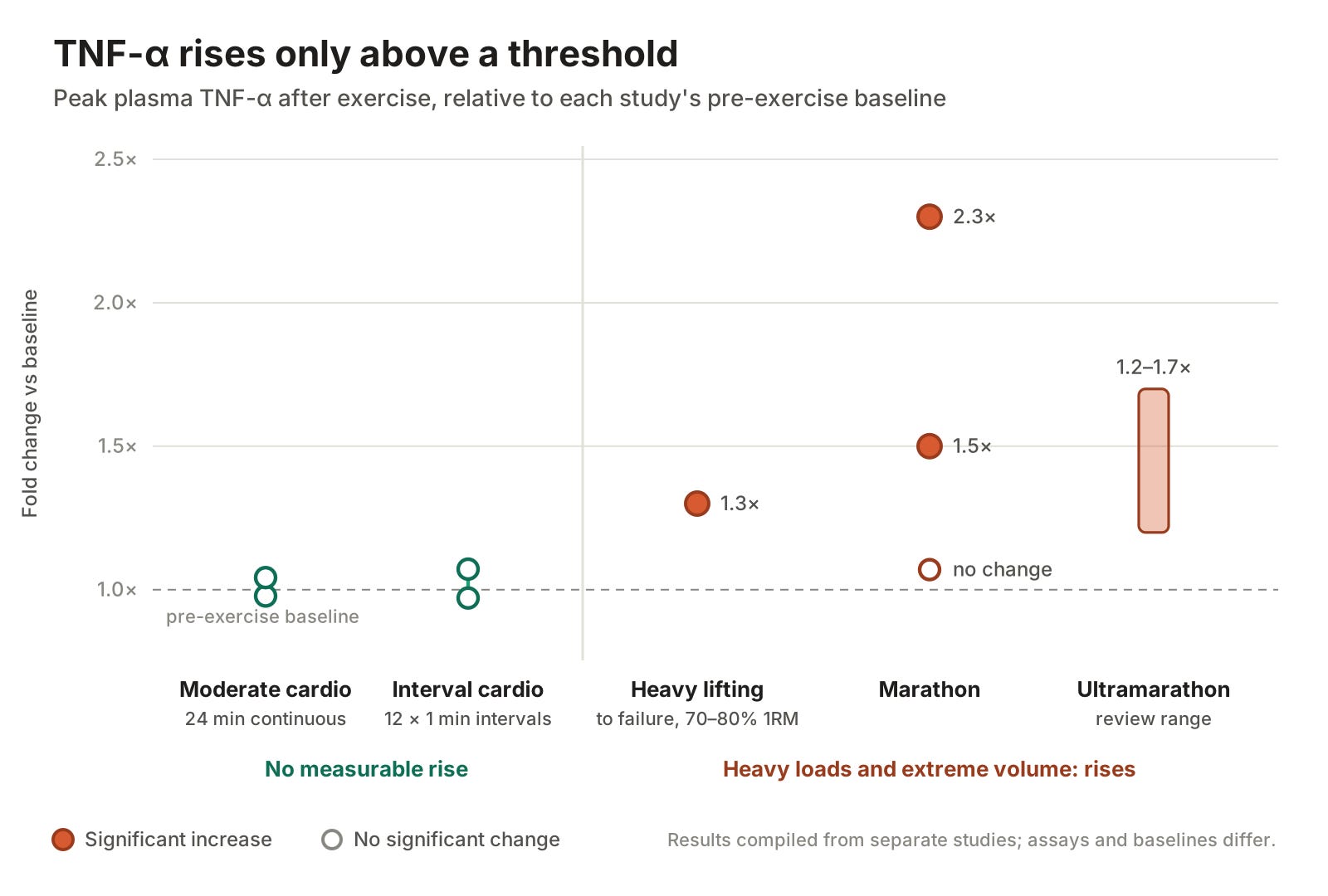
So it isn’t that every workout inflames you. Heavy, damaging or very long sessions cross a line that ordinary exercise doesn’t. If you do those most days, your fat cells spend more of the week exposed to a signal that tells them not to regenerate.
The gaps are real. These are blood levels, not levels in facial skin. The rise is modest and short. Nobody has measured fat cell regeneration in the skin after a heavy session. And it’s body-wide, so on its own it doesn’t explain why the face goes first. But if facial fat depends more on renewal, a body-wide brake on regeneration would show there first.
Suspect 4: the sun
The Times piece barely mentions it, but most of the athletes it describes train outdoors. A woman who quit running put it well: hours outside, pounding or pedalling, won’t leave you looking fresh-faced.
UV does reach the fat under the skin. In human skin, sun exposure draws immune cells into that fat and slows how much new fat it makes (Kim 2018). So for outdoor athletes, it’s a real contributor, and the most fixable one.
But I don’t think it’s the main driver. The jujitsu practitioner in the Times piece trained indoors, and plenty of people with gym face do their training under fluorescent lights. I’d treat the sun as something that makes gym face worse, not something that causes it.
What doesn’t fit, and what we don’t know
If bounce were the whole story, runners would get gym face and cyclists wouldn’t. But the doctors in the Times piece named cyclists and rowers too, and the jujitsu practitioner trained indoors. So bounce can’t be the only cause. Cyclists and rowers still burn fat the same way, and long rides and races cross the inflammation threshold. My guess is that the factors add up, and different athletes get there by different mixes.
Age is the other piece. The people in the article were mostly in their late thirties and up. By then, new fat cell formation in the skin has already slowed. That’s been measured directly in human cells (Caso 2013; Liu 2024). An older face has less capacity to absorb an extra hit.
What we don’t know is a long list. No one has studied gym face directly. No one has compared facial fat in runners, cyclists and swimmers at matched body fat. No one has measured fat cell turnover in the face of a hard-training athlete. Everything above is a hypothesis built from human trials, cell studies, animal studies and clinical observation. I think it’s a good one. It needs testing.
What you can do about it
First, keep exercising. Nothing here is an argument for doing less of something that’s so good for your health, and for your skin. It’s an argument for paying attention to how you do it.
If the hypothesis is right, these should help:
If you train outdoors, protect your face. Train early or late, wear a brimmed hat or visor, use sunscreen. It’s the easiest change, even if it isn’t the whole story.
Give your body gaps. Build in real recovery days, and don’t stack heavy sessions to failure back to back.
Mix in lower-impact work. If you run a lot, some of your volume could come from cycling, swimming or the rowing machine.
Eat enough protein. I recommend about 0.7 grams per pound of body weight. Regeneration needs raw material.
The Times piece was mostly about fillers and Sculptra. Those are real options, and for some people they’re the right ones. They add volume from outside rather than supporting the skin’s own fat cells.
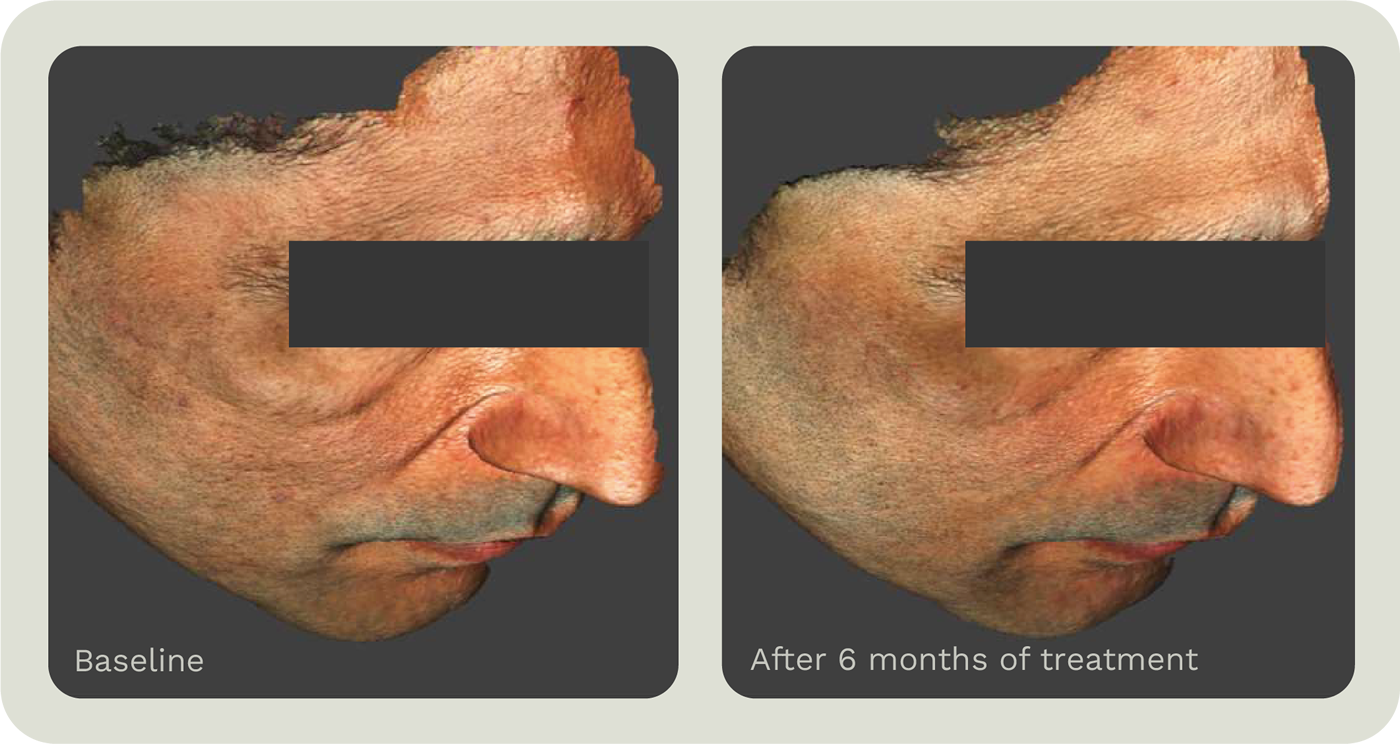
If facial fat really does run on renewal, that’s the process worth supporting. It’s why we created Adipeau: to boost the skin’s natural capacity to regenerate fat cells. In our 3D clinical studies, subjects gained 1.4 cc of volume per side of the face over 6 months. The gains were highly selective to the areas of the face that were depleted.
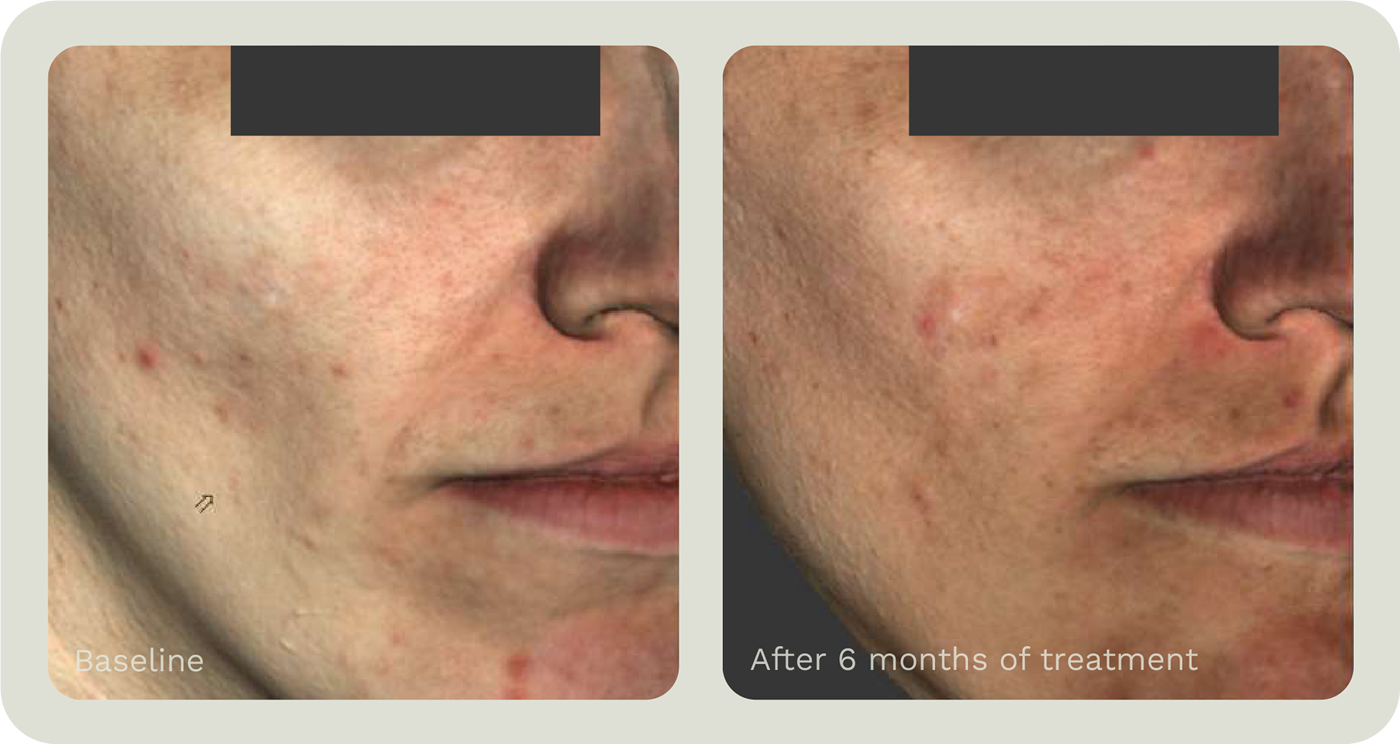
In our registered clinical study (NCT04769193, published with the Karolinska Institute in 2026), facial volume measured by 3D imaging kept increasing between month 3 and month 6 of using Volume Cream. That study was not done in athletes. I don’t know how people with gym face specifically would respond, and I won’t pretend to.
What I can say is that facial fat cells keep regenerating your whole life. The process can be slowed down. It can also be supported. Gym face can get better, with our products and without them.
You can check out the Strength Gel here.
Tell me if I’m wrong
If you train hard and you’ve watched your face change, I want to hear from you. What do you do, how much, indoors or out? Did anything help? And if you think I’ve got the science wrong, I want to hear that too. Leave a comment below or reply to this email. I read every message.
Sources
Bee P. Are you suffering from “gym face”? The Times, 2 December 2014.
Wedell-Neergaard AS, Lang Lehrskov L, Christensen RH, et al. Exercise-induced changes in visceral adipose tissue mass are regulated by IL-6 signaling: a randomized controlled trial. Cell Metab. 2019;29(4):844–855.e3.
Lyngsø D, Simonsen L, Bülow J. Interleukin-6 production in human subcutaneous abdominal adipose tissue: the effect of exercise. J Physiol. 2002;543(Pt 1):373–378.
Spalding KL, Arner E, Westermark PO, et al. Dynamics of fat cell turnover in humans. Nature. 2008;453(7196):783–787.
Rivera-Gonzalez GC, Butka EG, Gonzalez CE, et al. Comparative single-cell lineage tracing identifies distinct adipocyte precursor dynamics in skin and inguinal fat. Cell Stem Cell. 2025;32(8):1267–1284.e8.
Chon SH, Pappas A. Differentiation and characterization of human facial subcutaneous adipocytes. Adipocyte. 2015;4(1):13–21.
Shoham N, Gefen A. Mechanotransduction in adipocytes. J Biomech. 2012;45:1–8.
Tanabe Y, et al. J Cell Sci. 2004;117:3605–3614.
Turner NJ, et al. Biochem Biophys Res Commun. 2008;377:1147–1151.
Sen B, et al. Endocrinology. 2008;149:6065–6075.
Tirkkonen L, et al. J R Soc Interface. 2011;8:1736–1747.
Rubin CT, Capilla E, Luu YK, et al. Adipogenesis is inhibited by brief, daily exposure to high-frequency, extremely low-magnitude mechanical signals. Proc Natl Acad Sci USA. 2007;104(45):17879–17884.
Sen B, et al. J Biomech. 2011;44:593–599.
Hara Y, et al. Sci Signal. 2011;4:1–11.
Kato H, et al. Tissue Eng Part A. 2010;16:2029–2040.
Windsor MT, Bailey TG, Perissiou M, Meital L, Golledge J, Russell FD, Askew CD. Cytokine responses to acute exercise in healthy older adults: the effect of cardiorespiratory fitness. Front Physiol. 2018;9:203.
Townsend JR, Hoffman JR, Fragala MS, et al. TNF-α and TNFR1 responses to recovery therapies following acute resistance exercise. Front Physiol. 2015;6:48.
Ostrowski K, Rohde T, Asp S, Schjerling P, Pedersen BK. Pro- and anti-inflammatory cytokine balance in strenuous exercise in humans. J Physiol. 1999;515(Pt 1):287–291.
de Sousa CAZ, Sierra APR, Martínez Galán BS, et al. Time course and role of exercise-induced cytokines in muscle damage and repair after a marathon race. Front Physiol. 2021;12:752144.
Ramirez D, et al. Effects of marathon running on inflammatory cytokine levels: acute increases and 48-hour resolution. Abstract, National Conference on Undergraduate Research (NCUR), 2025.
Waśkiewicz Z, Mukhambet Z, Azerbayev D, Bondarev S. Inflammatory response to ultramarathon running: a review of IL-6, CRP, and TNF-α. Int J Mol Sci. 2025;26(13):6317.
Kim EJ, Kim YK, Kim S, Kim JE, Tian YD, Doh EJ, Lee DH, Chung JH. Adipochemokines induced by ultraviolet irradiation contribute to impaired fat metabolism in subcutaneous fat cells. Br J Dermatol. 2018. (Add volume and pages from PubMed.)
Caso G, et al. 2013. PMID 22999012.
Liu et al. 2024. PMID 38914551.
Taebnia et al. Comput Struct Biotechnol J. 2026. (NCT04769193)